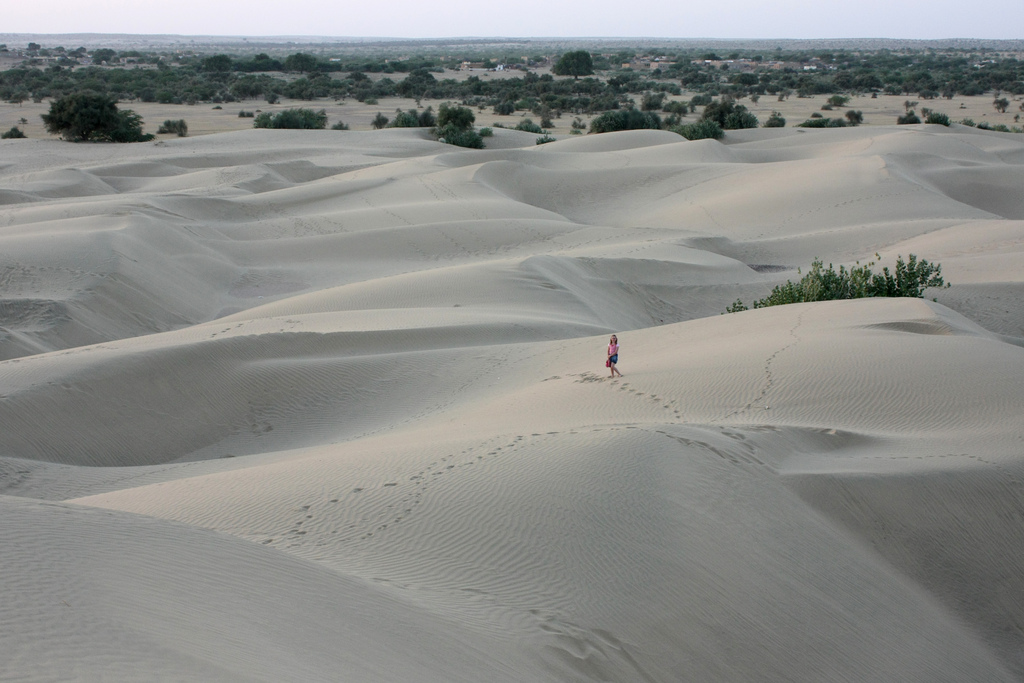
Jaisalmer
is also known as "The Golden
City", is a town in the Indian state of Rajasthan. The town stands on a ridge of
yellowish sandstone, crowned by a fort, which contains the palace and several
ornate Jain temples. Many of the houses and temples are finely sculptured. It
lies in the heart of the Thar Desert and
has a population of about 78,000. It is the administrative headquarters of Jaisalmer District.
History:
-
The majority of any inhabitants of Jaisalmer are Bhatti Rajputs, who take their name from an ancestor named Bhatti, renowned as a warrior when the tribe were located in the Punjab. Shortly after this the clan was driven southwards, and found a refuge in the Indian desert, which was henceforth its home. This area was part of Gurjara - Pratihara empire and till 11 centuary was ruled by a powerful Bargujar King.Deoraj, a famous prince of the Bhati family, is esteemed the real founder of the Jaisalmer dynasty, and with him the title of rawal commenced. In 1156 Rawal Jaisal,[1] the sixth in succession from Deoraj, founded the fort and city of Jaisalmer, and made it his capital as he moved from his former capital at Lodhruva (which is situated about 15 km to the south-east of Jaisalmer). In 1293, the Bhattis so enraged the emperor Ala-ud-din Khilji that his army captured and sacked the fort and city of Jaisalmer, so that for some time it was quite deserted. Some Bhatti's migrated to Talwandi, now Nankana Sahib in Distt. Nankana Sahib (Punjab, Pakistan) and others settled in Larkana (in Sind, Pakistan)under the name of Bhutto. In Nankana Sahib, the Bhatti Clan can be traced from the lineage of Rai Bhoe and Rai Bular Bhatti. After this there is nothing to record until the time of Rawal Sahal Singh, whose reign marks an epoch in Bhatti history in that he acknowledged the supremacy of the Mughal emperor Shah Jahan. The Jaisalmer princes had now arrived at the height of their power, but from this time till the accession of Rawal Mulraj in 1762 the fortunes of the state rapidly declined, and most of its outlying provinces were lost. In 1818 Mulraj entered into political relations with the British. Maharawal Salivahan, born in 1887, succeeded to the chiefship in 1891.
The Maharajas of Jaisalmer trace their lineage
back to Jaitsimha,
a ruler of the Bhatti Rajput clan. The major opponents of the Bhati Rajputs
were the powerful Rathor clans of Jodhpur and Bikaner. They used to fight battles for the
possession of forts, waterholes or cattle. Jaisalmer was positioned strategically and was a
halting point along a traditional trade route traversed by the camel caravans
of Indian and Asian merchants. The route linked India to Central Asia, Egypt,
Arabia, Persia, Africa and the West.
During the Islamic invasion of India, Jaisalmer escaped direct Muslim conquest due to its geographical situation in the desert region. The Rawals of Jaisalmer agreed to pay an annual tribute to the Delhi Sultans. The first siege of Jaisalmer occurred during the reign of Alauddin Khilji. It was provoked by Bhatis' raid on a caravan filled with treasure. According to local ballads, the Bhatis defended the fort for seven years until the enemy army forced beached the ramparts. Bhatis, facing certain defeat, proclaimed the rite of jauhar. Later, Sultan Ferozshah also sieged Jaisalmer after the rulers of Jaisalmer raided his camp at Anasagar lake near Ajmer. The siege led to another jauhar. Jaitsimha's son Duda perished in the attack. Duda's descendants ruled over Jaisalmer for about two centuries. Duda's descendant Lunakarna had a fight with Humayun when the latter passed through Jaisalmer en route to Ajmer. Mughal emperor Akbar was married to one of the Jaisalmer princesses.
Later, Jaisalmer was ruled by a noble called Sabala Simha, who won the patronage of the Mughal emperor Shah Jahan for services rendered in his Peshawar campaign.
Visitor’s
attraction: -
Built in 1156 by the Bhati Rajput ruler Jaisal,
it is situated on Trikuta Hill and had been the scene of many battles. Its
massive sandstone walls are a tawny lion color
during the day, turning to a magical honey-gold as the sun sets. The famous
Indian film director Satyajit Ray
wrote a detective novel and later turned it into a film – Sonar Kella (The Golden Fortress) which
was based on this fort. This is a living fort and about a quarter of city's
population still live inside the fort. The main attractions inside the fort
are: Raj Mahal (Royal palace), Jain
temples and the Laxminath temple.
The main havelis in Jaisalmer are:
Patwon-ki-Haveli: Guman Chand Patwa (and later by his five sons), a wealthy merchant and banker who had over three hundred trading centres from Afghanistan to China. This ornate five-storey complex took fifty years to complete. This is the largest, the most magnificent, and the most elaborate of Jaisalmer havelis.
Salim Singh-ki-Haveli: It was built by the scheming Prime Minister Salim Singh in 1815. It has a beautifully arched roof capped with blue cupolas and carved brackets in the form of peacocks.
Nathmalji-ki-Haveli: Built by a Prime Minister of princely state of Jaisalmer. Its facade is a riot of ornamentation: flowers, birds, elephants, soldiers, a bicycle and even a steam engine.
Simla Haveli': this is a 500 year old builing in jaisalmer fort
Mehra haveli: Built by Gopikishan Mehra ,Mayor of Jaisalmer city.He named haveli after his grandmother Parwati davi Parwati Sadan
Haveli Shreenath [5]
Desert Culture Centre & Museum
Jaisalmer Folklore Museum
Government Museum
Mehra Haveli