Bikaner is a District in the northwest of the state of Rajasthan in northern India. The city is the
administrative headquarters of Bikaner District and Bikaner division. It was
formerly the capital of the princely state of Bikaner. The city
was founded by Rao Bika in 1486 and from its small
origins it has developed into the fourth largest city in Rajasthan. Just like
Jaipur, Bikaner is called the Green City. The Ganga Canal completed in 1928 and the Indira
Gandhi Canal completed
in 1987 have allowed the farming of crops such as mustard, cotton and wheat.
Other industries include wool production and the mining of gypsum, plaster
of Paris and bentonite.
Attractions in Bikaner and nearby
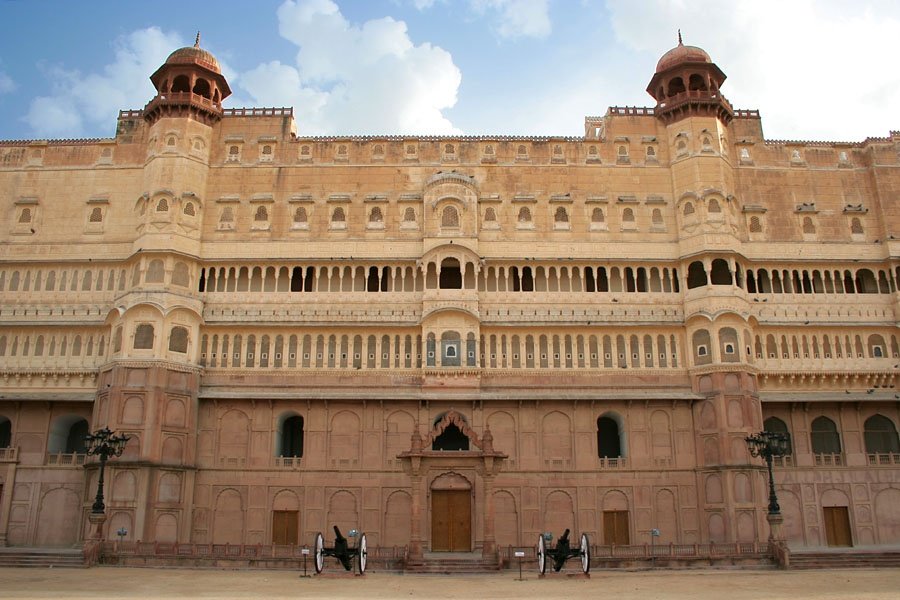
Junagarh
Fort, Bikaner, Rajasthan, India
The fort was built by Raja Rai Singh, the sixth ruler of Bikaner
who reigned from 1571 to 1612. Rai Singh had conquered part of Marwar and had
been granted territory in Gujurat and Burhanpur by the Mughal emperor Akbar as
a reward for his services as military commander. This, as well as funding from
Jodhpur, enabled him to build the fort. Rai Singh held high rank in the
imperial courts of both Akbar and his successor, Jehangir. During his imperial
service he travelled extensively, giving him an appreciation of art and
architecture. These ideas have been incorporated meticulously into the
architectural style of Junagarh Fort.
Laxmi Niwas Palace
The Laxmi Niwas Palace is a former residential palace of the
king of the former Bikaner state, Maharajah Ganga Singh in Bikaner in the
Indian state of Rajasthan. It was designed by the British architect, Sir Samuel
Swinton Jacob in the year 1902. The style of architecture is Indo-Saracenic. It
is now a luxury hotel owned by Golden Triangle Fort & Palace P. Ltd. The
magnificent structure in red sandstone is one of the most popular destinations
for tourists in Bikaner.
Lalgarh Palace
Lalgarh Palace was built between 1902 and 1926 according to
Rajput, Mughal and European architectural styles. The building was commissioned
by Maharaja Ganga Singh (1881 - 1942) in memory of his father Maharaja Lall
Singh and was designed by the British architect, Sir Swinton Jacob. It is
coated in red sandstone and has several grand halls, lounges, cupolas and
pavilions. The building features magnificent pillars, elaborate fireplaces,
Italian colonnades and intricate latticework and filigree work. The palace
houses the Shri Sadul Museum as well as the fourth largest library in the
world. Though the Bikaner Royal Family still live in the palace, part of the
building has been converted into a hotel operated by the WelcomHeritage Group.
Constructed in 1486, Moolnayakji was the first Vaishnav
Temple built in Bikaner. It was the principal seat of the Vaishanv sect. The
first of the Bhagavad Katha Vachaks of the Rattani Vyas clan of Bikaner Shri
Rattoji Vyas gave the Bhagavad Updesh to the king, Rao Bika and his aide
Salloji Rathi. This practice is still carried on today. The presiding deity is
Lord Moolnayak Krishna.
Laxmi Nath Temple
Laxmi Nath Temple is one of the oldest temples in Bikaner.
The foundation of the city was laid here in 1488 by Rao Bikaji. The temple was
erected during the reign of Rao Lunkaran and was added to by Maharaja Ganga
Singh.
Kolayat is a famous pilgrimage spot with a temple dedicated
to Kapil Muni who, according to his devotees, sat in meditation near the lake.
Karni Mata Temple
The shrine of Karni Mata can be found in the town of
Deshnoke 30 km south from Bikaner on the road to Jodhpur. Karni Mata is
worshiped as an incarnation of Goddess Durga.
Shiv Bari Temple
