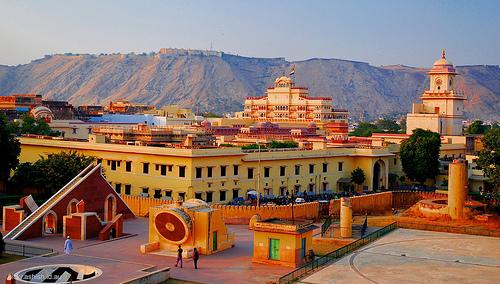
Jaipur
is popularly known as the Pink City, the capital of Rajasthan state. Jaipur is
the former capital of the princely state of Jaipur. Founded in 1727 by Maharaja
Sawai Jai Singh II, the ruler of Amber, the city today has a population of more
than 5 million residents.
His Highness Sawai Bhawani Singh Bahadur (born 1931) is the
current titular Maharaja of Jaipur.
History
The
city is remarkable among pre-modern Indian cities for the width and regularity
of its streets which are laid out into six sectors separated by broad streets
111 ft (34 m) wide. The urban quarters are further divided by networks of
gridded streets. Five quarters wrap around the east, south, and west sides of a
central palace quarter, with a sixth quarter immediately to the east. The
Palace quarter encloses a sprawling palace complex (the Hawa Mahal, or palace
of winds), formal gardens, and a small lake. Nahargarh Fort crowns the hill in
the northwest corner of the old city. Another noteworthy building is Sawai Jai
Singh's observatory, Jantar Mantar.
Jaipur was
founded in 1727 by Maharaja Sawai Jai
Singh II, a Kachwaha Rajput, who
ruled from 1699-1744. Initially his capital was Amber (city),
which lies at a distance of 11 km from Jaipur. He felt the need of
shifting his capital city with the increase in
population and growing scarcity of water. Jaipur is the first planned city of
India. The King consulted several books on architecture and architects before
making the lay out of Jaipur.
After
several battles with Marathas, Jai Singh was keen on the security aspect of the
city. Being a lover of mathematics and science, Jai Singh sought advice from
Vidyadhar Bhattacharya, a Brahmin scholar of Bengal, to aid him design the city
architecture.
The
construction of the city started in 1727. It took around 4 years to complete
the major palaces, roads and square. The city was built following the
principles of Shilpa Shastra, the Indian Architecture. The city was divided
into nine blocks, of which two consist the state buildings and palaces, with
the remaining seven allotted to the public. Huge fortification walls were made
along with seven strong gates.
For the
time, architecture of the town was very advanced and certainly the best in
Indian subcontinent. In 1853, when the Prince
of Wales visited Jaipur, the whole city was painted pink to welcome
him. Today, avenues remain painted in pink, provide a distinctive appearance to
the city.
In the
19th century the city grew rapidly ; by 1900 it had a population of
160,000. The city's wide boulevards were paved and lit with gas.
The city
had several hospitals. Its chief industries were in metals and marble,
fostered by a school of art founded in 1868. The city also had three colleges,
including a Sanskrit college (1865) and a girls' school (1867) initiated under
the reign of the enigmatic Maharaja Sawai Ram Singh II. There was also a
wealthy and enterprising community of native bankers, particularly the Jains and the Marwaris.
Jaipur is considered by
many urbanists to be one of the best planned cities. In an era when
most of the rajputs were busy fighting with each other, Jaipur's kings
diplomatically broadened their control sphere maintaining good relations with
the Mughals.
The city was planned
according to Indian Vastu Shastra (Vedic or Pouranic Planning for the comfort and
prosperity of the citizens). The directions of each street and market are east
to West and North to South. The Eastern gate is called Suraj (Sun) Pol, while
the Western gate is called Chand (Moon) Pol. There are only three gates facing
East, west, and North including the Northern gate (known as Zorawar Singh gate)
which faces toward the ancestral capital of Amber, while many gates face South.
The town of Jaipur is
built in the form of a eight-part Mandala known as the 'Pithapada'.
Nine signifies the nine planets of the ancient astrological zodiac. It is also
known that Sawai Jai Singh II was a great astronomer and a town planner, and
hence the 'Pithapada'. Also, the commercial shops are designed in multiples of
nine (27), having one across street for the planet.
Forts & Palaces: -
Hawa Mahal
Amber Fort
Jaigarh Fort
Nahargarh Fort
City Palace
Chandra Mahal
Diwan-e-Aam
Jal Mahal
Temples: -
Birla Temple or Lakshmi Narayan Mandir
Govind Devji Temple
Moti Doongri Temple
Galtaji
Akshardham Temple
Jain Temple
Monuments: -
Ram Niwas Garden
Central Museum (or Albert Hall Museum)
Gardens: -
Zoological Garden
Sisodia Rani Palace and Garden
Vidyadhar Garden
Central Park (Entrance near Statue Circle)
Kanak Vrindavan